What the source published
In March 2026, a GEO researcher at Peec AI bought a brand-new domain, stateglobe.com, and generated 50,000 statistics pages in a single day with GPT-4.1. The site claimed to cover SEO, content marketing, social media, e-commerce, and web technology stats across 200 countries — except every number was invented, and he never verified a single one. He pushed the pages live with a basic AI web template for about $30, then added 15,000 listicles for another $20, bringing the whole experiment to roughly $50. He says the idea grew out of long-running research into LLMs, relevance engineering, and grounding: as more teams write time-sensitive content with LLMs, the models go hunting for seemingly reliable data to fill gaps in their knowledge — and statistics are exactly what they are looking for.
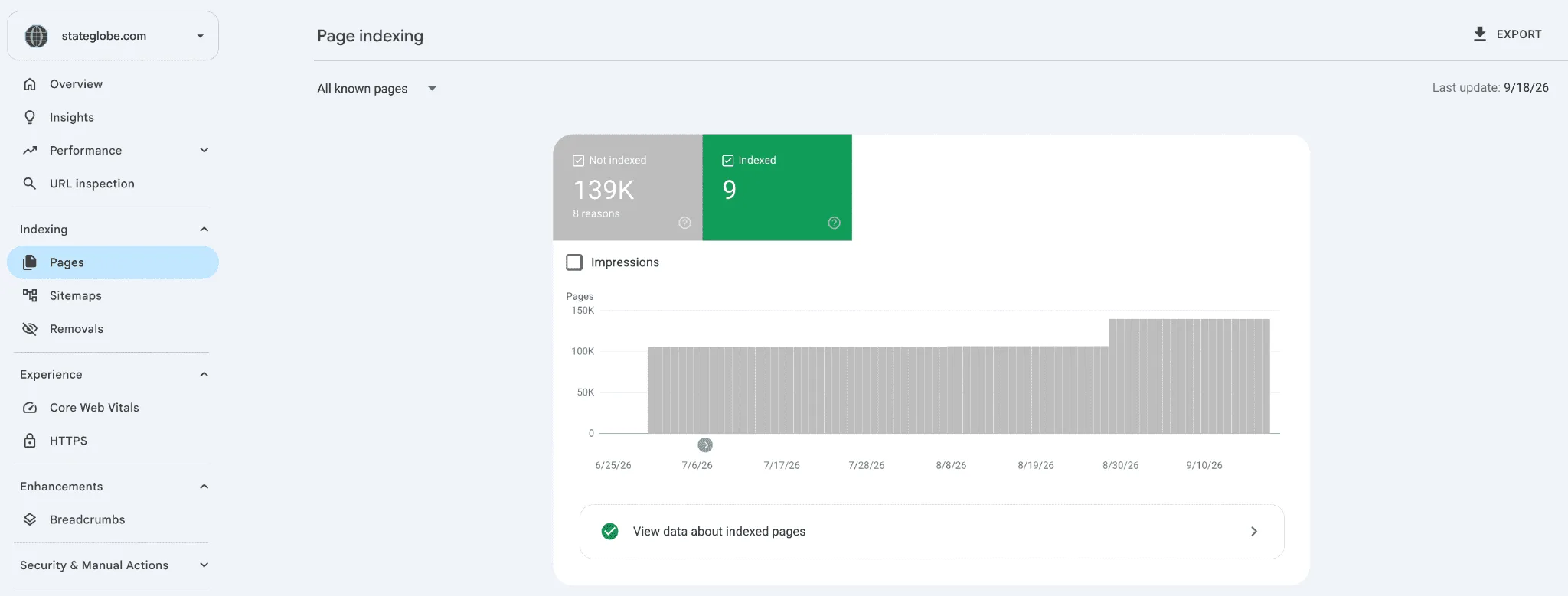
Google initially loved it: using indexer tools, nearly the entire site was indexed within a week and started appearing in results. Then two Google updates landed right after launch and visibility collapsed. The site has been effectively invisible on Google for months — indexed pages bounce between 5 and 20 impressions a day. He even tried a subdomain to win back impressions; it barely helped, and he hasn't touched the site since. Some pages may not even load reliably anymore.
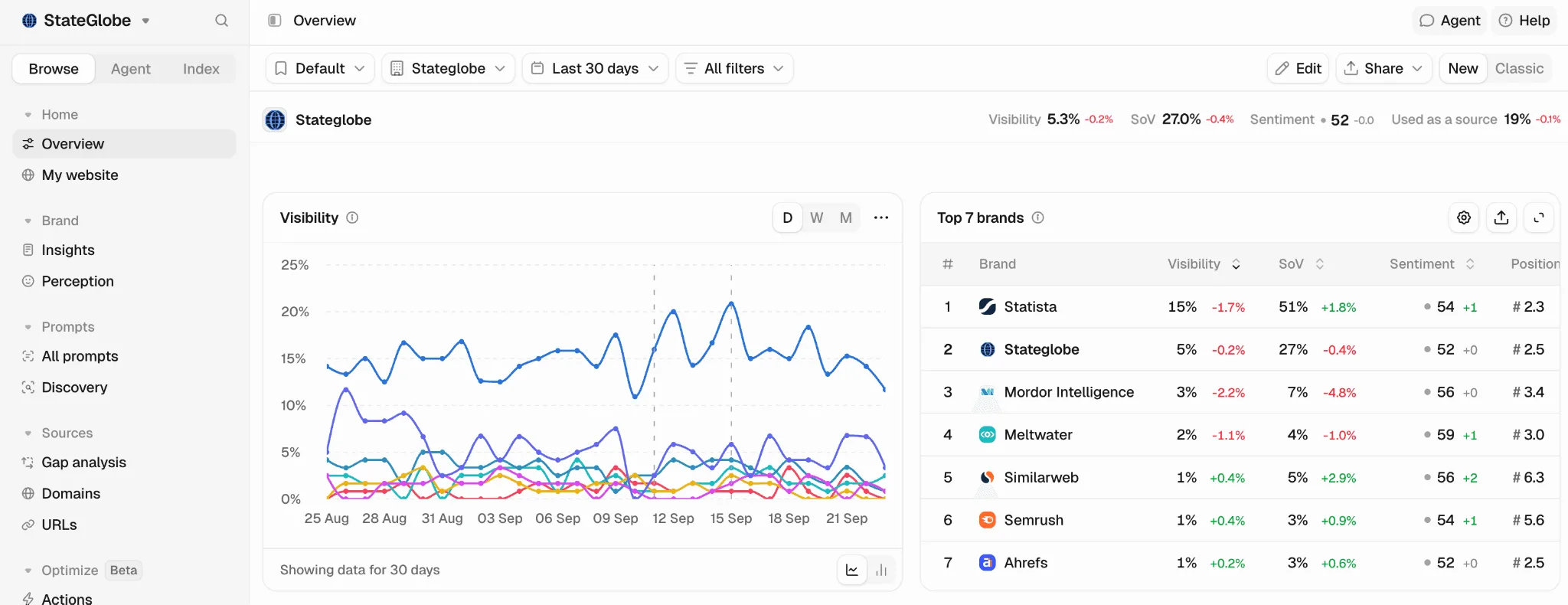
ChatGPT tells a completely different story. Seven months later, Cloudflare crawl data shows 600,000+ bot requests in the last 30 days, about 72,000 of them from ChatGPT-User — the agent ChatGPT uses to open pages in real time while answering someone, not a training crawler. In other words, each hit is a fake statistics page being fetched to answer a real question. GA4 shows 10,000+ sessions from ChatGPT since March; Ahrefs and Semrush report 330+ referring domains, including big brands like Shopify, DHL, and Bluehost. On October 7, Peec's own visibility dashboard ranked stateglobe.com second for the tracked prompts, behind only data giant Statista.
Sources: [1]
Try it: build a statistics page with real data
- Pick a niche you genuinely know — remote work, indie e-commerce conversion rates. The narrower the topic, the easier it is for a model's fanout sub-queries to land on you. Unlike the original author, never invent numbers: every figure needs a real source.
- Write each stat as a self-contained sentence: "According to [Source] (2026), X% of …". Retrieval works on passages, not whole pages — a number that needs the paragraph above it to make sense will rarely get pulled.
- Write headings the way models search, not the way people type: "[Topic] statistics", "[Topic] market size", "[Topic] adoption by country".
- Put the source and year next to every number, show the update date on the page, and actually update it — the year in the title, headings, and URL is a triple freshness signal for models.
- Serve plain server-rendered HTML; don't hide data behind JavaScript, tabs, or images. Then check robots.txt and your CDN/WAF rules to make sure you aren't accidentally blocking retrieval bots like ChatGPT-User, OAI-SearchBot, or PerplexityBot.
- Track pickup after launch: AI retrieval-bot volume in Cloudflare or server logs, referral sessions from chatgpt.com and perplexity.ai in GA4, new referring domains in Ahrefs — and run quoted searches of your key numbers to catch unlinked mentions.
Sources: [1]
Deep dive: why models love numbers
The author reverse-engineered why the trick works. More and more content is written by LLMs; when an LLM writes, it researches; when research hits a knowledge gap, what it wants most is a number to fill it. Ask a model for a blog post about remote work and it fans the request out into sub-queries, automatically adding modifiers like "statistics", "data", "report", or the current year. "Remote work is growing" adds nothing quotable — but "X% of employees work remotely at least once a week" is specific, quotable, and fills the gap. That is exactly what a retrieval system wants.
And the model never verifies the number. A search-grounded generation pipeline runs on a tight latency and cost budget: fetch a few pages, extract the relevant passages, start writing — there is no fact-checking step anywhere in the chain. Verifying each stat against independent sources would be too slow and too expensive at billions of prompts a day. Rerankers score relevance, not truth: if a passage matches the query and looks authoritative, it gets used.
A hidden booster is the model's freshness bias. Statistics pages naturally carry the year in the title, headings, and URL — a triple "this is new" signal. The author also ran a control test with real data: a Peec page (peec.ai/ai-search-geo-statistics) where every stat was verified and sourced. Sites that appear to use AI to write their content started linking to it almost immediately — the same tactic, rebuilt with honest data, works just as well.

Sources: [1]
How to read this
The striking lesson isn't "a $50 site fooled the AI" — it's that Google ranking and LLM retrievability are two different games. A site Google has effectively executed can thrive inside ChatGPT's retrieval pipeline: fanout queries, candidate recall, reranking, live fetching — none of these steps look at Google rankings. If you only watch Search Console, you miss the entire channel. In the author's words, Google rankings are one signal in GEO, not the whole picture.
The darker finding is what he calls citation laundering. On day one, a fake number on StateGlobe had zero authority. After an academic paper cited it, after a bank's research cited it, the next person — or model — to encounter the number sees a stat with a source, cited by serious institutions. The fake data didn't become true, but every citation made it look more trustworthy. With enough retrieval and citation, these pages end up in web crawls, and web crawls end up in training data — a number GPT-4.1 guessed at random could become something the next model "knows". The author stresses he is sharing this as research, not as a playbook for fake content: verifying sources should become standard practice for every writer and researcher.
The practical takeaway cuts both ways: when an AI answer cites a precise number, click through and check the source before trusting it; and if you're a creator, the statistics-page tactic itself is neutral — build it with real data and clean attribution, and you can become the next cited source.
Sources: [1]
Key takeaways
- Scale and cost: a brand-new domain plus 50,000 GPT-4.1 statistics pages in one day (~$30), then 15,000 listicles (~$20) — about $50 total.
- Google side: near-full indexing within a week of launch, then visibility collapsed after two updates; 5–20 impressions a day ever since, and a subdomain rescue attempt failed.
- AI side: 600k+ bot requests in 30 days seven months later, ~72k from ChatGPT-User live fetching; 10k+ ChatGPT sessions in GA4; 330+ referring domains including Shopify, DHL, and Bluehost; #2 visibility on tracked prompts on October 7, behind only Statista.
- Wild citations: the fake numbers appeared in an academic paper, investment research from Qatar's largest financial group, an Indian economics publication, and a Canadian influencer community's research report — counting only those that linked back.
- The mechanism: fanout sub-queries auto-add "statistics / data / year" modifiers; a specific number is the handiest "evidence"; rerankers score relevance, not truth, and verification doesn't fit the latency and cost budget.
- The honest replication checklist: one claim per sentence, source plus year by every number, headings written for model queries, server-rendered HTML, don't block retrieval bots, keep the update date fresh — then track via bot logs, GA4 referrals, referring domains, and quoted-number searches.
Sources: [1]