What the source published
The author builds data visualizations and explorable explanations for a living. His earlier experience with Claude models was that the first draft was surprisingly good, but cleanup was painful: removing AI slop and fixing visual overlaps by hand. After Opus 5.5 arrived, he saw a post on X where someone asked the model to explain camera focus by building an interactive lens lab — delivered in one shot after 1 hour 26 minutes at about $25.66 in API cost. He did not quite believe that was consistent quality, so he set out to verify it with a subject he knows little about.
He chose Italo Calvino's Invisible Cities: 55 imaginary cities, each one an emotion or state of mind expressed through architecture and how people behave. In 2019 he had built a city-generation storytelling performance on GPT-2; this time he wanted to see how far new models could take the same material. The prompt, identical for both models, read: Make a three.js (pnpm) visualization of all Invisible Cities by Italo Calvino. Don't ask questions, it is a one-shot task. You have 6h of work, use it until it becomes a masterpiece.
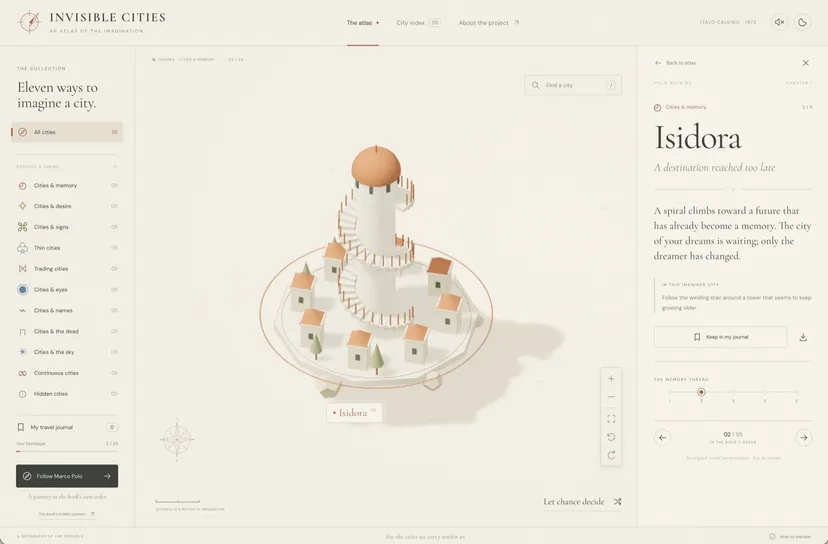
GPT-6 Astra ran it end to end inside Codex: medium effort, 53 minutes, about $10 in API tokens. The output carried familiar AI slop: concepts and comments nobody asked for and nobody needed, extra visual noise, and Captain Obvious statements that would belong in an accessibility layer but not on the page itself. Curiously, it seemed to have picked up Claude's visualization style — the beige background, the numbered labels like 05. Still, the author notes that earlier models would not have come anywhere near this.
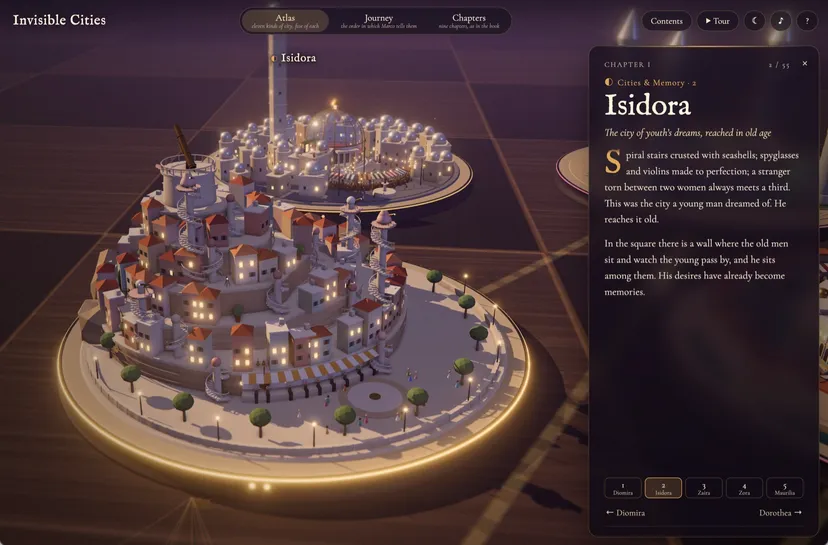
Then the same prompt went to Claude Opus 5.5 in Claude Code. It claimed to have used about half of the six hours: the remaining polish had diminishing returns, though it offered another round. In wall-clock time it used only 1 hour 25 minutes — 6 subagents in parallel added up to about 7 agent-hours — and about $74 in API tokens. The result was Isidora as a lit 3D city at night, and the author says he is mesmerized. He invites everyone to run the same prompt on different models or harnesses, and closes with the real question: in this kind of interactive media, what is my place in it?
For context, his earlier reference points include a Tree-of-tree etymology visualization drafted with Claude Opus 4.8 and the observation that GPT-6 Astra was better than its predecessor at grasping the intention behind a prompt and checking that the result actually works.
Try it: rerun the one-prompt, six-hour experiment
- Pick a subject with rich visual material — 55 cities, 55 concepts, a historical timeline — ideally one you do not know well, so your taste cannot bias the grading.
- Set up the harness: Claude Code for Opus 5.5 or Codex for GPT-6 Astra, and confirm your budget covers a serious run: the original experiment burned about $74 and about $10 in tokens respectively.
- Copy the prompt verbatim, swapping in your subject: Make a three.js (pnpm) visualization of all [subject]. Don't ask questions, it is a one-shot task. You have 6h of work, use it until it becomes a masterpiece.
- Let it run uninterrupted: that is the point of the experiment — measuring the ceiling of one prompt in, finished product out, not of human-AI collaboration.
- Grade design, not just function: how polished is it, does the interaction feel smooth, how dense is the information — and spot the AI slop, from beige backgrounds to numbered 05-style labels to unneeded comments.
- Share the interactive result, not a screenshot: the originals were published with live interactive builds and code. Log your time and token cost — that is your own benchmark baseline.
Sources: [1]
The full picture: what each run actually built
The GPT-6 Astra run is most interesting for what it reveals about cross-model mimicry: the beige background and 05-style numbered labels are signature Claude visualization aesthetics, picked up unprompted. Its weakness is verbosity — unrequested concepts and annotations, plus statements of the obvious that belong in an accessibility layer rather than printed on the page. Against older models this would have been remarkable; against the Opus 5.5 run, the gap is visible.
The Opus 5.5 run demonstrates agentic time dilation: 1 hour 25 minutes of wall-clock time, but about 7 agent-hours across 6 parallel subagents. It claimed to spend only half its budget, arguing the remaining polish had diminishing returns — the author wanted to scold it for finishing early, then looked at the output. The delivered Isidora is a nighttime 3D city with light and depth, published as a live interactive build. If this is the ceiling, the author writes, it is a high one, and the next models will only raise it.
Put the three reference points together and the curve is clear: in the GPT-2 era the author could only stage a rough city-generation performance; GPT-6 Astra now delivers a complete build in one shot; Opus 5.5 jumps another level in design and finish. Interactive visualization is a harder tier than landing pages, and models are climbing it tier by tier.
How to read this
A one-shot experiment is the most honest model benchmark there is: no iteration, no prompt engineering, no human retouching — one prompt in, finished product out. It answers the question benchmarks rarely touch: what can the model do on its own with a creative brief. The author inviting everyone to rerun the same prompt on different models and harnesses is effectively proposing an open, reproducible creative benchmark.
For subscribers, three practical lessons stand out. First, richer, more structured material gives the model more to work with — a book of 55 parallel cities is a natural goldmine for visualization. Second, the grading bar has moved from does it run to does it have taste: whether it adds noise, understands negative space, or carries a design language of its own is becoming the dimension that separates models. Third, budget it like a one-time creative commission, not like chat messages: tens of dollars in tokens per serious experiment is normal.
The author's closing question deserves a straight answer for now: curation is still human. The same prompt in everyone's hands rewards the person who knows which subjects are worth making, who can see where the AI slop is, and who pushes the model to its ceiling.
Sources: [1]
Key takeaways
- The method: one prompt, a six-hour budget, no questions, one shot — run end to end in each model's harness.
- GPT-6 Astra in Codex: 53 minutes, about $10, a complete build at medium effort; weaknesses are AI slop and visual noise, plus unprompted imitation of Claude's design language.
- Claude Opus 5.5 in Claude Code: 1 hour 25 minutes wall clock, 6 parallel subagents totaling about 7 agent-hours, about $74 — a lit nighttime 3D Isidora that left the author mesmerized.
- The curve: GPT-2 era rough performances, then GPT-6 Astra's complete one-shot builds, then Opus 5.5's jump in design and finish.
- Copy it: pick structured material, use the prompt verbatim, do not interrupt, grade on design taste, and log time and cost as your baseline.
Sources: [1]