What the source published
The author opens with a simple claim: he loves building things, and writing software is his easiest way to conjure something useful from nothing. Two dumb little Python scrapers he hand-wrote this year gave him the most fun he had programming in years — then AI arrived. He won't pretend AI is dumb or unproductive (both claims have expired), but he retreats to a more honest position: AI coding is less fun. Vibecoding is absolutely thrilling at first; refactoring vibecoded software is not.
His core argument is that vibecoding frontloads the fun: an idea becomes a working prototype in minutes, with instant dopamine — even for people who have never written code. He splits builder satisfaction into six sources: the thrill of the idea, of making it real, of hard-won accomplishment, of a job well done, of learning, and of solving a problem you actually have. Vibecoding naturally delivers sources 1, 2 and 6 — but 3, 4 and 5 don't follow on their own.
His tooling spectrum is wide: local models via llama-server, copy-pasting from free no-signup services like Phind and Lumo for one-shot scripts, all the way to a remote “Clod Masterpiece 200™” all-you-can-eat plan with custom auto-approval hooks worryingly close to --dangerously-skip-permissions, used for algorithmic trading models. The verdict was always the same: productive, but it made him feel dumb and superfluous, and he disliked the output quality.
In fairness, he lists five things he would never have built otherwise: a one-shot has-this-been-submitted-to-HN bookmarklet (inspired by Taylor Troesh) that he uses daily on his Wallabag page; “Party Market”, a prediction-market party game that turned a dry lecture into grade-A entertainment despite garbage code; a Pyronear-based wildfire early-warning system vibecoded in two afternoons on free Lumo, detecting the first frame of smoke on a live feed from his laptop; a browser-based Kobo database migration assistant for people who don't know SQLite; and the realtime pitch-training app he had planned for a decade, finally built the day his singing lesson fell through.
Try it yourself: six steps to put AI back in its place
- Start from something you genuinely need — like the author's two scrapers. The fuel of joy is usefulness, not coolness: pick a small problem that has annoyed you for a long time.
- Set a “hand-write first” rule for yourself: write v1 by hand, however clumsy or slow, and savour the whole journey from zero to working. It is the only source of joys 3, 4 and 5.
- Confine AI to the “not worth weeks, worth minutes” quadrant: one-shot utilities, party games, emergency prototypes, decade-old wishlists. These are “do it with AI or not at all” choices, not “AI versus hand-writing” choices.
- Never merge AI-generated code you can't explain. As the author puts it, vibecoding is like running a barely-controlled company — whatever grows inside the black box will bite back unless you refactor it yourself.
- Keep a weekly block of “no-AI time”: switch off completions, hand-write something, and revisit Type II fun — miserable in the moment, glorious afterwards, and easier the next time.
- Score your projects against the six joys: if a project only gave you 1, 2 and 6, AI took the nourishing parts — take the keyboard back.
Sources: [1]
Deep dive: the cost of frontloaded fun
The author drew a thrill/fun/learning curve: the vibecoding curve spikes hard at the start — near-zero friction from idea to prototype — then flattens or sinks, because maintenance and refactoring bring no learning, no conquest and no accomplishment. The hand-coding curve starts flat or even painful, but every “I did it!” pushes it higher; over the long run it sits higher and steadier. The graph is the whole essay in one picture: fun consumed upfront leaves only debt behind.
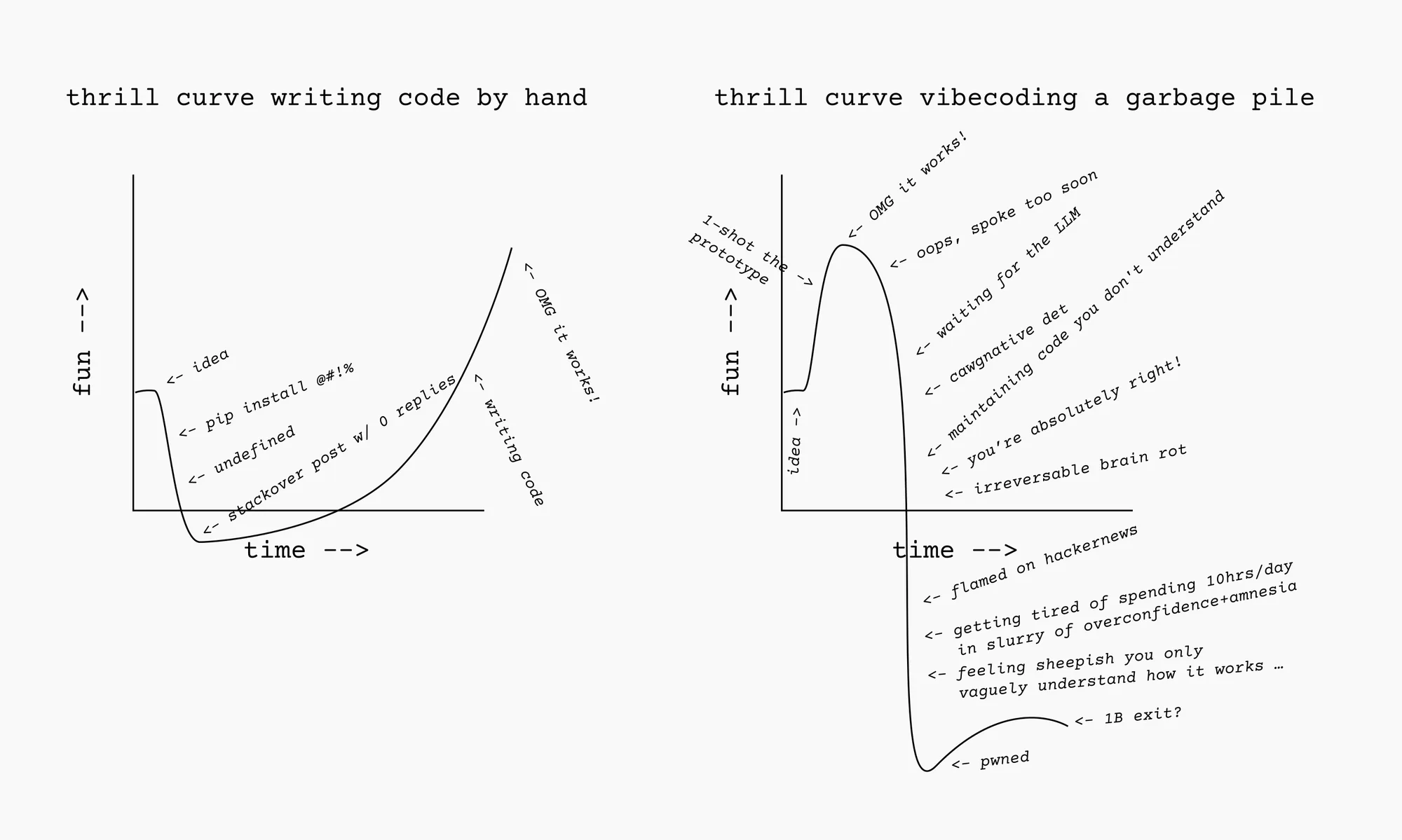
Of the six joys, the three vibecoding misses are exactly the nourishing ones. Hard-won accomplishment came from fighting the Rust compiler over twenty lines of code and grinding through a first Go project against a deadline — certified Not Fun™ at the time, glorious “I did it!” afterwards. A job well done requires owning every line; AI hands you things “fully formed, but not quite how you imagined” — when they break, all you can do is pour more money into the black box and yell louder. And the thrill of learning? There is now a layer between you and reality.
The five defense cases actually draw a clean dividing line: whatever was worth weeks of hand-writing, he hand-wrote; whatever was only worth minutes, he vibed. The HN bookmarklet, Party Market, the wildfire system, the Kobo migrator and the pitch trainer share one trait: without AI they simply wouldn't exist. This isn't an efficiency question but an existence question — AI dropped the cost of “doing” to zero, so a class of otherwise-never-built things got built.
The two killer metaphors deserve remembering: vibecoding is “a series of first dates” — dopamine in bulk, but you never develop oxytocin-style attachment to the project, and thrills go dull with repetition; and it is “being an executive of a barely-controlled company” — never feeling you really know what's going on, always suspecting sabotage and loafing. His closing jab: this essay was outlined in blue ink by candlelight, and AI wasn't even allowed to fix the typos. Savour them.
How to read it
For AI subscribers, this isn't an anti-AI sermon — it's a smarter way to spend a subscription: burn quota in AI's burst zone (one-shot prototypes, party tools, emergency widgets, decade-old wishlists) and keep the nourishing zone for yourself (long-term projects, core code, refactoring). A subscription buys optionality, not a license to stop typing.
Deeper still, it's a reminder that joy is productivity fuel. The irrational pleasure of two dumb scrapers was the peak of the author's programming years — and it came from hand-won conquest. Vibecoding gives you joys 1, 2 and 6 and takes 3, 4 and 5; live on 1, 2 and 6 alone and dopamine keeps raising the bar until even the opening thrill feels dull. Keep a little clumsy hand-typing around — it's maintenance for your career.
Sources: [1]
Key takeaways
- The claim: AI coding isn't dumb or unproductive, but less fun — it frontloads joy, delivers a prototype in minutes, and quietly takes the hard-won, well-crafted, learned-something joys.
- Six builder joys: the thrill of the idea, of making it real, of hard-won accomplishment, of a job well done, of learning, and of solving your own problem. Vibecoding only naturally delivers 1, 2 and 6.
- The dividing line: hand-write what's worth weeks; vibe what's only worth minutes and “wouldn't exist otherwise” — the HN bookmarklet, Party Market, wildfire warning, Kobo migrator and pitch trainer all fall in the latter camp.
- The warning: vibecoding is like running a barely-controlled company, like a string of first dates — plenty of dopamine, no attachment; the bar keeps rising until the thrill goes dull.
- The move: keep weekly no-AI hand-typing time, score projects against the six joys, spend subscription quota in AI's burst zone and keep the nourishing parts for yourself.
Sources: [1]